When Fake News, Scams, and Cloaking All Meet in One Place
An investigation into how fake news, investment fraud, and cloaking combine into a single victim-selection and monetisation infrastructure.
Analytical brief
Key findings
- Cloaking separates potential victims from researchers and platform controls.
- Fake-news content acts as a trust and traffic-generation layer.
- Infrastructure and template overlaps connect campaigns more reliably than a single domain.
- Scope
- Analysis of fraud traffic, routing logic, and differential content delivery to audiences.
- Limitations
- The infrastructure changes quickly, so domains and redirect paths represent a point-in-time view.
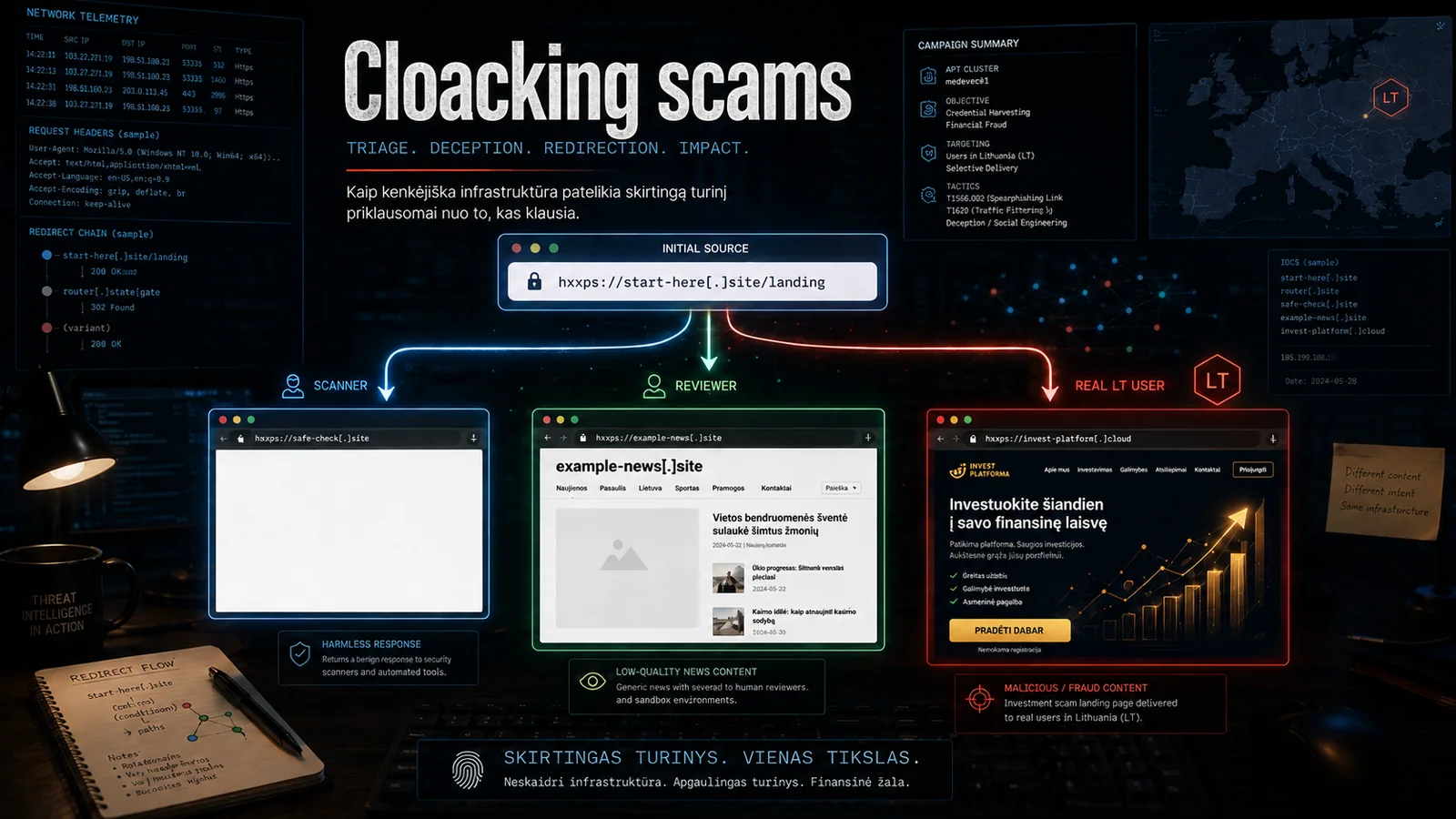
WeRedirect APT (I just don’t know why it’s called APT here, when it doesn’t really correspond to the concept of APT, although on the one hand the company has infrastructure, operators, cloaking, advertising farms, APT-like, persistent scam operation or some organized fraud actor would still fit financially motivated threat actor is more suitable here) is the name given by Debunk.org to a company where fraudsters in Lithuania and other European countries created cloned news portals, fake Facebook accounts, landing investment scams pages and used cloaking to show different content to different visitors. Debunk.org part I identified 93 Facebook accounts, 81 brand impersonation pages, 568 fake ads and 7.5 million. impressions, of which more than 5.1 million impressions went to Lithuanian Facebook users and other meta platforms. (Debunk.org, 2023 Part I)
The most important technical point is that the same URL is not the same proof, aka one person can see an empty page, another a bad one, and a person from Lithuania (with the right device, language, referrer and IP reputation) can see a fake Delfi/LRT/Ignitis investment page. Debunk part 3 described that WeRedirect used geolocation/IP-based redirection, different URL path variants, low-quality pages and selected content accordingly (Debunk.org, 2023 Part III)
What is Cloacking in the context of CTI
Cloaking in the context of phishing and malvertising is the control of content presentation based on certain characteristics of the visitor. For security scanner, ad reviewer, cloud sandbox or researcher (for researcher or whatever you call it, you won’t spoil it) the “normal” page is displayed. Phishing, scam, crypto drainer, fake investment platform, malware landing page, or some fake installer is displayed to the targeted user. Hero in 2026 the described case of 1Campaign shows that exactly the same model takes place in the Google Ads ecosystem, i.e. real users see scam content, while ad platform reviewers and automated scanners see a blank page or a harmless page. (Hero, 2026)
HUMAN Security 2025 in the malvertising analysis, cloaking presented it as a “split personality” advertising model, which is the same as 1Campaign. (HUMAN Security, 2025)
ZeroFox lists the typical characteristics of a cloaked phishing kit: JavaScript rendering requirement, User-Agent filtering, timing delays, IP blocklists, geo-blocking and domain rotation/DGA. He also mentions that phishing kits often block web crawlers, searchers, bots and other “undesirables”. (ZeroFox, 2023)
Well, I’m going to intervene here too (who else but a dog will lick itself…), when I was still at NordVPN ThreatProtection, we also wrote a little about cloaking and caught 2024. (my team wrote…only NordVPN experts are left…sad). (NordVPN, 2024)
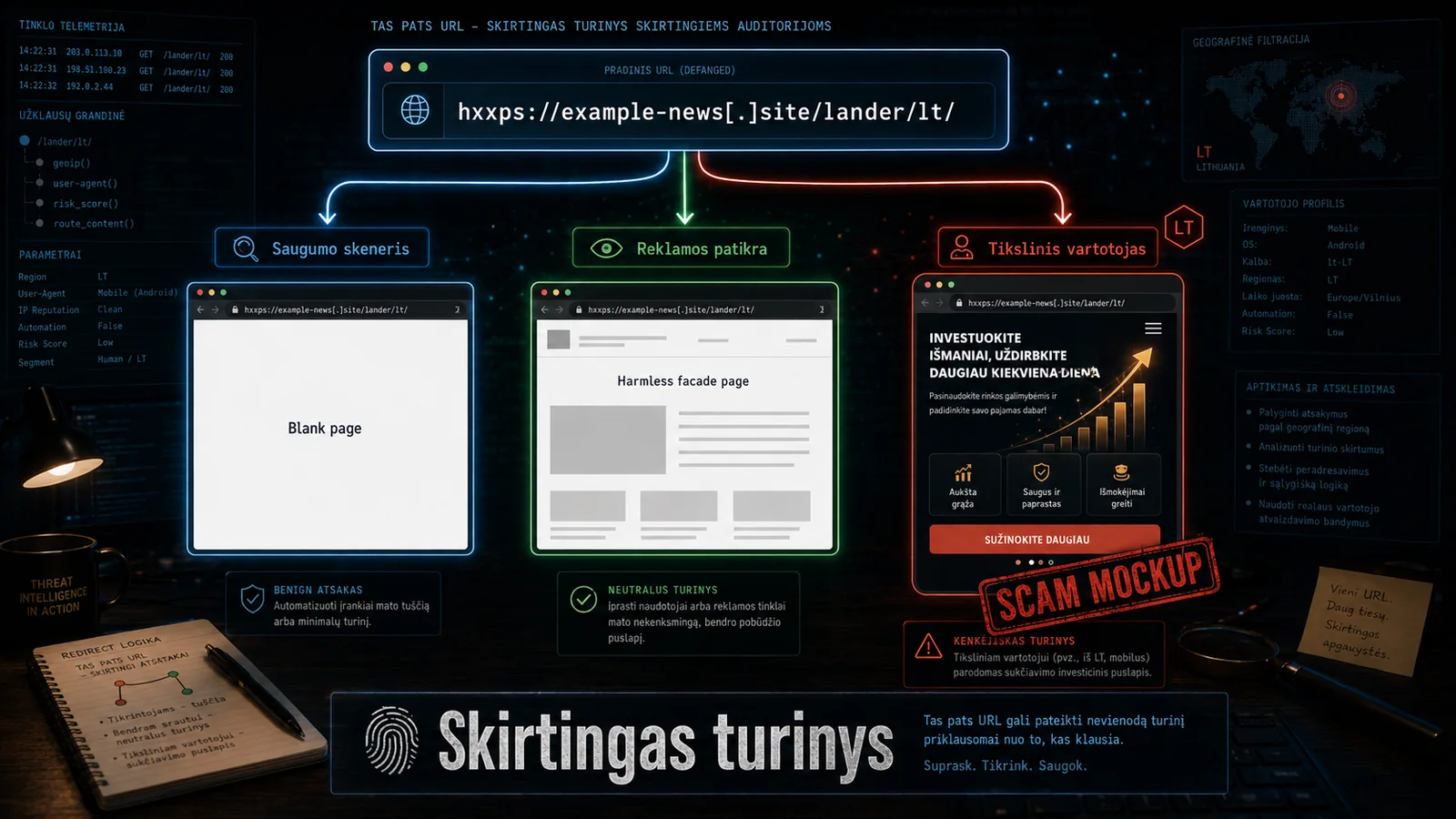
Basic cloaking techniques
Techniques
| Technique | How it works | What the analyst sees | How to detect | ||
|---|---|---|---|---|---|
| Geo/IP filtering | Server resolves by IP country, region, ASN, residential/mobile/datacenter type | You can see white page or 404 | from cloud/VPN Test from various mobile/residential/datacenter profiles | ||
| ASN / hosting reputation filtering | Blocks Google, Microsoft, AWS, OVH, DigitalOcean, VPN, security vendors | Scanners receive a benign page | Compare cloud vs residential/mobile answers | ||
| User-Agent filtering | Tests Chrome/Safari/Firefox, OS, mobile/desktop, bot UA | Headless Chrome or curl gets a different HTML | Change UA, Accept-Language, platform headers | ||
| JavaScript rendering gate | Content is generated only with JS, cookies, localStorage, timers | Static scanner sees empty HTML | Use Playwright/Chrome with HAR and screenshots | ||
| Headless/browser fingerprint detection | Checks navigator.webdriver, plugins, fonts, WebGL, canvas, screen size | Automation gets the facade | Compare real browser and headless results | ||
| Referer / ad-click gating | The real version is displayed only when coming from Meta/Google ad click | Direct URL opening does not work | Collect full ad URL with parameters, referrer and redirect chain | ||
| Cookie/session gating | First visit shows one content, repeat another | After some research, the page “closes” | Use clean sessions, new profiles, capture first hit | ||
| Time delay | Scam content appears after 5-30s or after scroll/click | A fast scanner does not manage to see | Extend wait time, record DOM changes | ||
| Path-based landers | The same domain has many localized /lander/lt..., /lander/se... paths | One path does not work, the other shows scam | Enumerate only from publicly visible paths, compare structure | ||
| Shield pages | The initial lander looks like a low-quality news/gossip page | Scanner sees pseudo portal | See JS, redirect initiators, form actions, hidden links | ||
| Sample-rate cloaking | The malicious version is only displayed for a portion of the sessions | One test may show nothing | Repeat from different environments, but safely and with limited | ||
| Anti-debugging / DevTools detection | JS checks debug/DevTools attributes | Opening DevTools changes behavior | Collect HAR via proxy/browser API, not just manual DevTools | ||
Localization gating Checks Accept-Language, timezone, currency, browser locale | The non-LT locale gets the facade | Test from different timezone | |||
| CAPTCHA / challenge gating | Phishing occurs after a challenge or interaction The scanner stops at the challenge stage | Document the challenge, do not enter personal data | |||
| Tracking/affiliate gating | Real lander is only active with fbclid, gclid, UTM, affiliate ID | After trimming the parameters, the page no longer works | Store the original URL with all parameters |
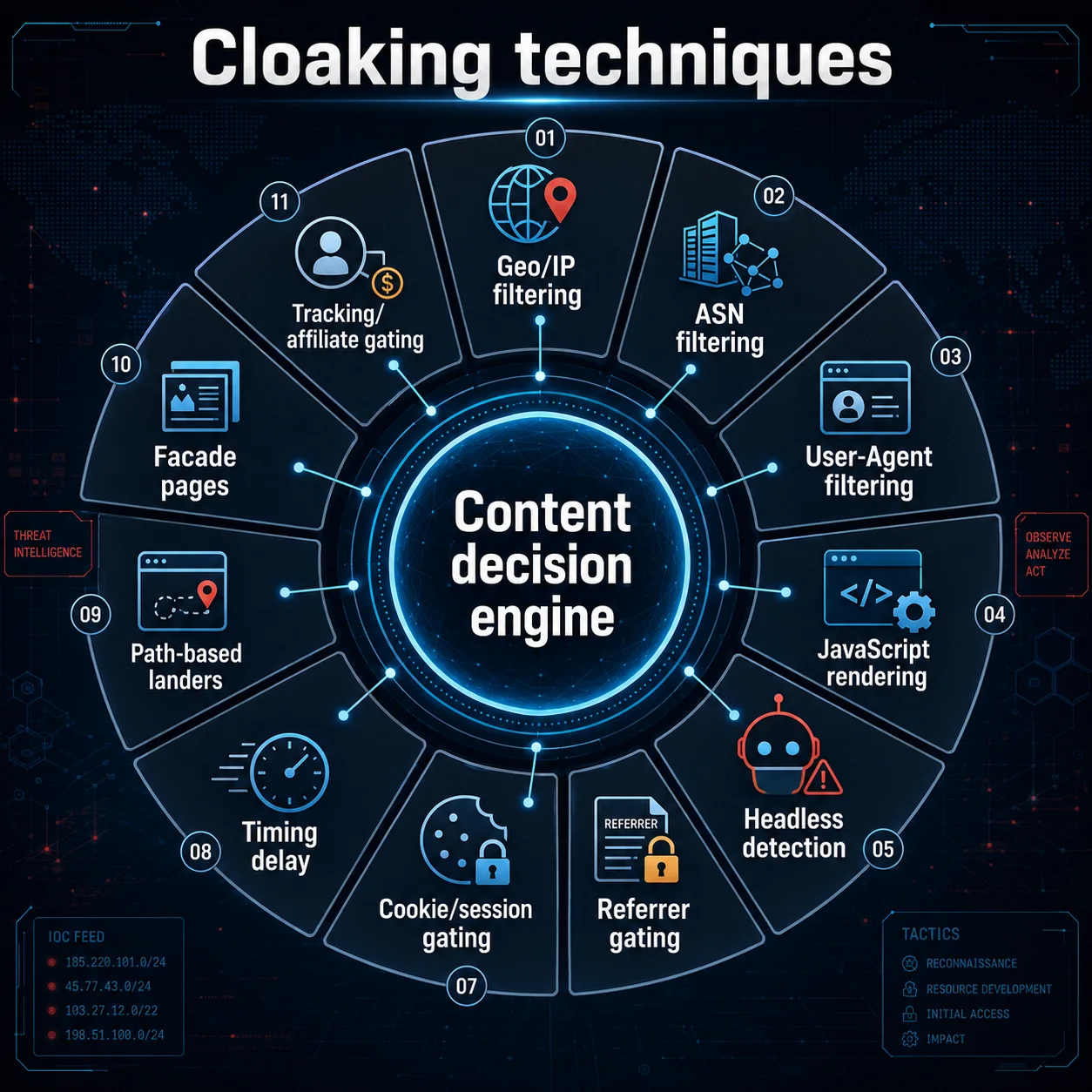
What is important here is not that technique is not a problem, but that problems arise when there are already combinations.
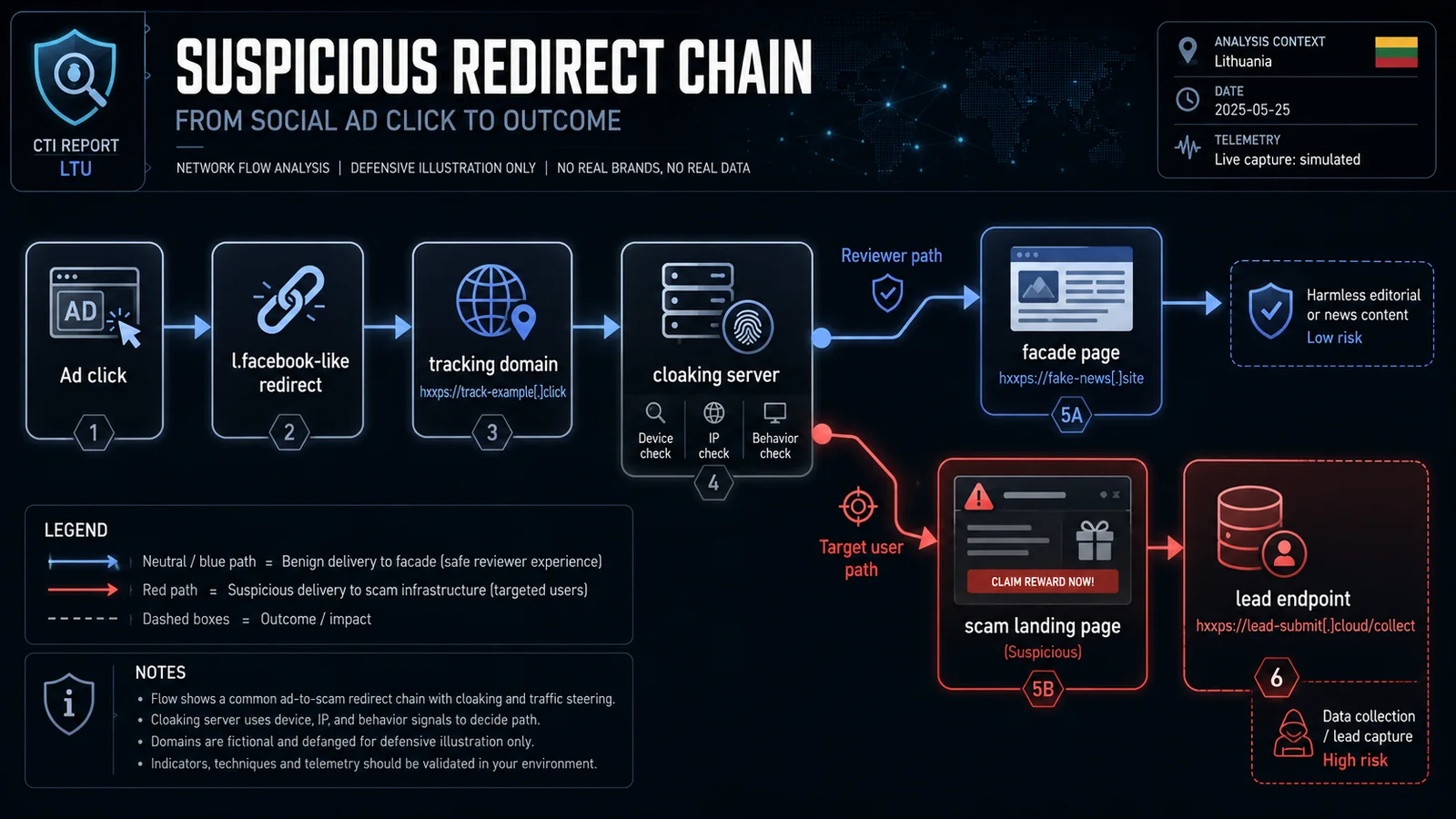
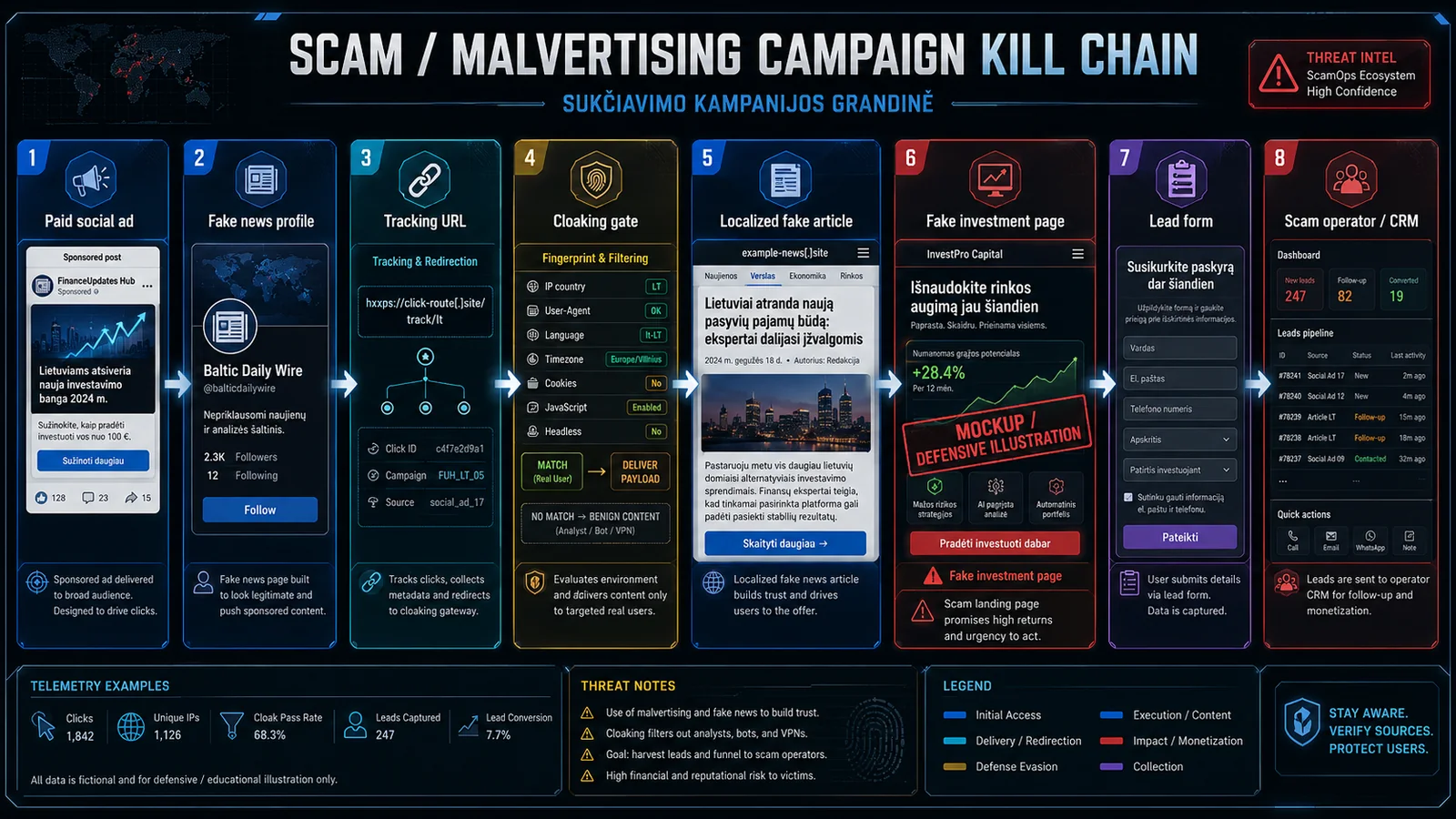
In real companies, not one logic works, but their combinations: Meta ad → fake news profile → tracking URL → Geo/IP check → UA check → cookie check → JS redirect → localized fake article → investment form → callback/CRM/Telegram/affiliate backend.
Catch it where you missed it… Uhhh fun.
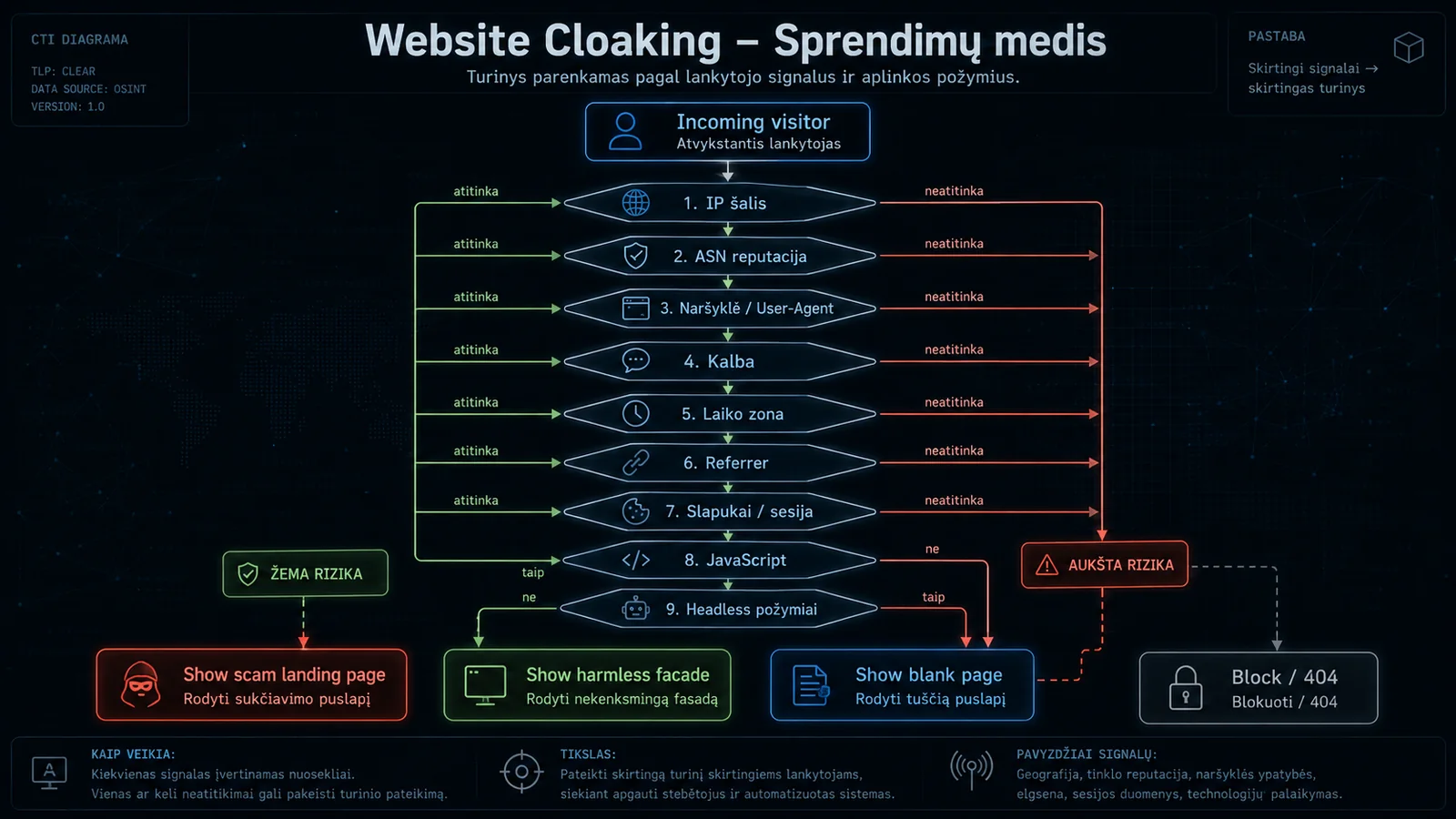
How to safely “decloak” and access real phishing/scam content
In short, it is the basis for collecting IOCs, screenshots, cloaking mechanism. We don’t store real data, we don’t buy anything, we don’t click download, we don’t run payloads… We don’t interact with operators more than is necessary to confirm a phishing/scam, if the forms require a phone number, bank card data, we don’t make it clear that it’s ours or someone else’s (actually, dummy data often comes into play here). We recorded form fields, endpoints, DOM, screenshots and network requests… and We are done.
Practical workflow (it looks something like this):
Passive-firstLet’s start with passive sources:
1
2
3
4
5
6
7
8
9
10
11
12
13
14
domain age and registrar
WHOIS / RDAP
nameservers
A/AAAA/CNAME
passive DNS
certificate transparency
ASN / hosting provider
favicon hash
page title / OpenGraph
Meta Ad Library creative metadata
social profile creation / rename history
brand keywords domene
URL path structure
UTM / affiliate / tracking ID
Debunk.org described registration time and domain creation clusters as beneficial for WeRedirect (it goes without saying that pivoting is The King). Some of the domains were created at a very similar time. Debunk also mentions Cloudflare, DigitalOcean, hosting providers, Namecheap, Tucows, URL Solutions, and privacy-protecting logging services as infrastructure layers that made the analysis difficult. (Debunk.org, 2023 Part III)
Differential fetchWe check the same URL for several conditions:
1
2
3
4
5
6
7
8
9
10
11
12
13
# Minimalus baseline
curl -i -L --max-redirs 10 "https://example[.]com/path" -o baseline.html

# More realistic Chrome desktop profile
curl -i -L --max-redirs 10 \
  -A "Mozilla/5.0 (Windows NT 10.0; Win64; x64) AppleWebKit/537.36 (KHTML, like Gecko) Chrome/126.0.0.0 Safari/537.36" \
  -H "Accept-Language: lt-LT,lt;q=0.9,en-US;q=0.8,en;q=0.7" \
  "https://example[.]com/path" -o chrome_lt.html

# Bot / scanner
curl -i -L --max-redirs 10 \
  -A "Googlebot/2.1 (+http://www.google.com/bot.html)" \
  "https://example[.]com/path" -o bot.html
In this case, we compare whether the same URL returns different codes, Location headers, HTML size, page title, JS Budle, cookies or final URL.
Browser-rendered collectionStatic curl is often not enough, in this case ZeroFox singles out JS rendering, timing delays and User-Agent filtering as typical cloaked phishing techniques, so browser-rendered analysis is also needed. (ZeroFox, 2023)
We use an isolated VM, Playwright/Chromium, a new browser profile for each test (I actually have over several hundred browser profiles to catch cloaking), without real accounts and without real data:
1
2
3
4
5
6
7
8
9
10
11
12
13
14
15
16
17
18
19
20
21
22
23
24
25
26
27
28
29
30
31
32
33
34
35
36
37
38
39
40
41
42
43
from pathlib import Path
from playwright.sync_api import sync_playwright

target = "https://example[.]com/path"
out = Path("evidence")
out.mkdir(exist_ok=True)

profiles = [
    {
        "name": "lt_chrome_desktop",
        "locale": "lt-LT",
        "timezone_id": "Europe/Vilnius",
        "user_agent": "Mozilla/5.0 (Windows NT 10.0; Win64; x64) AppleWebKit/537.36 (KHTML, like Gecko) Chrome/126.0.0.0 Safari/537.36",
        "viewport": {"width": 1366, "height": 768},
    },
    {
        "name": "mobile_android_lt",
        "locale": "lt-LT",
        "timezone_id": "Europe/Vilnius",
        "user_agent": "Mozilla/5.0 (Linux; Android 14; Pixel 7) AppleWebKit/537.36 (KHTML, like Gecko) Chrome/126.0.0.0 Mobile Safari/537.36",
        "viewport": {"width": 390, "height": 844},
    },
]

with sync_playwright() as p:
    for prof in profiles:
        browser = p.chromium.launch(headless=False)
        context = browser.new_context(
            locale=prof["locale"],
            timezone_id=prof["timezone_id"],
            user_agent=prof["user_agent"],
            viewport=prof["viewport"],
            record_har_path=str(OUT / f"{prof['name']}.har"),
        )
        page = context.new_page()
        page.goto(target, wait_until="networkidle", timeout=45000)
        page.wait_for_timeout(15000)

        (out / f"{prof['name']}.html").write_text(page.content(), encoding="utf-8")
        page.screenshot(path=str(out / f"{prof['name']}.png"), full_page=True)

        context.close()
        browser.close()
(don’t be offended by the “smart” python script, I’m not a developer..it’s him..and there is no universal decoder suitable for everything, the situation is not the same)
Matrix-based decloaking
One of the most practical ways (i think.. my opinion) is not “I opened the URL and looked”, but to create a matrix for testing, in other words.. the same URL must be checked through several profiles, the differences between the answers can already be proof that content decision logic is taking place.
To put it simply (taking Lithuania):
Tests
| Test | IP / location | Browser / UA | Language / timezone | Referer / parameters | What are we looking for? |
|---|---|---|---|---|---|
| In Baseline | Datacenter / EU | curl | default | none | Is the page live, what are the status codes |
| LT user | Lithuania | Chrome desktop | lt-LT / Europe/Vilnius | original URL | Does it show localized scam / fake news |
| LT mobile | Lithuania | Android/iOS mobile | lt-LT / Europe/Vilnius | original URL | Is the campaign mobile-first |
| Non-target user | US / NL / DE | Chrome | en-US | none | Does it show blank/facade/other content |
| Bot profile | anywhere | Googlebot/crawler UA | default | none | Are bots showing harmless content |
| Well, JS | Lithuania | Chrome, JS off | lt-LT | original URL | Do you need a JavaScript redirect? |
| Well, for days | Lithuania | Chrome | lt-LT | clip fbclid/utm | Are campaign tokens necessary? |
| Repeat visit | Lithuania | same in profile | lt-LT | original URL | Does the scam content close after a few times? |
From this point of view, not one test is important, but several (of tests) correlation. If curl gets 1.2KB HTML with empty <body>, Googlebot receives some low-quality news page, LT mobile profile receives a fake investment page with a form… we can say that we have cloaking.
Anyway, what else would be worth comparing this to:
1
2
3
4
5
6
7
8
# HTML sizes
wc -c baseline.html chrome_lt.html bot.html

# Hashs, if we want to quickly see if the content is identical
sha256sum baseline.html chrome_lt.html bot.html

# Fast grep of title / redirect / JS artifacts
grep -Eoi "<title>.*</title>|window.location|document.location|location.href|setTimeout|atob|eval|gtm|f
If one profile HTML has form, phone, firstname, lastname, submit, pixel, fbq, gtm (I know swear words..), and the HTML of the other profile is empty or shows random bad (eg mine), that paranoia can be thrown out the window, we have two faces on one page.
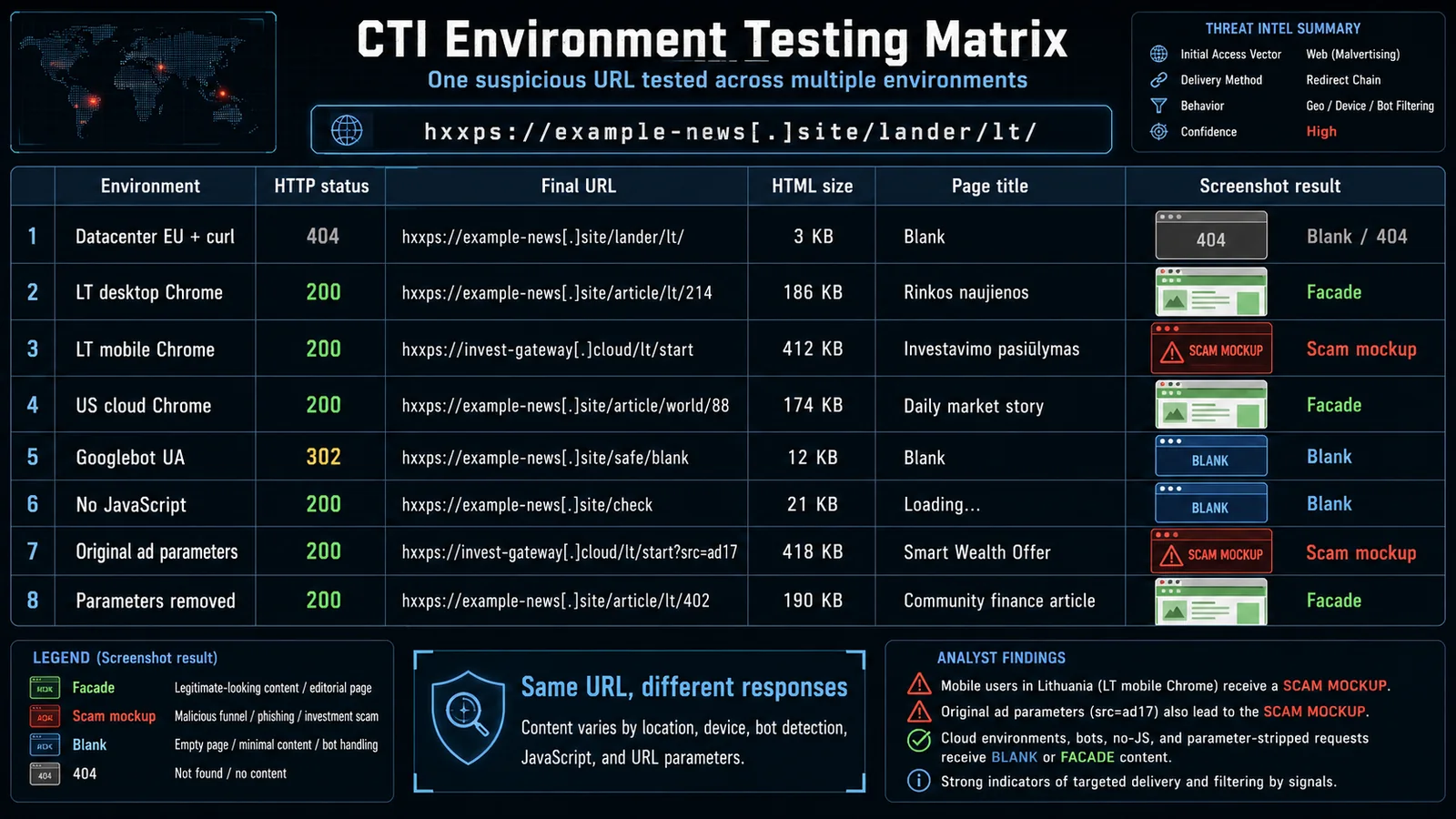
What exactly to compare
When we are already collecting certain evidence, just a screenshot is not enough (this one is for managers and Linkedin only), we need some technical analysis and more info.
If I have to catch possible cloaking… I collect artifacts:
Artifacts
| Artifact | Why is it important? |
|---|---|
| Final URL | Shows where the redirect chain actually ended |
| HTTP status codes | 200/302/403/404 differences between profiles indicate gating |
| Location headers | Helps to see server-side redirects |
| HTML body size | Blank vs full lander can be seen very quickly |
| Page title | Fake news / investment template identification |
| Cookies | Session gating may be used |
| localStorage/sessionStorage | JS based decision flags |
| HAR file | Complete request/response tree |
| Screenshot | Visual proof of brand impersonation |
| JS files | Redirect, fingerprinting, tracking logic |
| Form action endpoint | Where does user data go? |
| Tracking IDs | GA/GTM/Meta Pixel/affiliate clustering |
| Referrer chain | Does the user have to come from a Facebook/Google ad |
| DNS/ASN/SSL | Infrastructure pivoting |
Here, one of the best signals is not the domain, but the repetitive logic. We all know that domains change/rotate (I hope everyone knows, if not, don’t thank me for this info, it was hidden here under TLP:Amber), Landing pages will change. Beeeettt.. as I mentioned in that blog about pivoting, operators often leave the same redirect pattern, the same JS fragment, the same form field naming, the same GTM container, the same affiliate parameter or the same path structure (I leave that big TLP:Amber at the bottom, who hasn’t read it)
In other words.. IOCs die and TTP lives on.

Basic cloaking techniques
I have already listed the main techniques in the mandram table above, and now let’s get to the how-to.
There is not much mysticism here, cloaking is not some super elite “APT Magic”, it is mundane (and many uses) web control layers are only combined into one decision engine.
Geo/IP based cloaking.
The server checks which country the visitor is coming from. If the visitor is from Lithuania (here I will use Lithuania everywhere, it will be easier to understand) it shows him the fake Delfi / Ignitis / Orlen / Investment page. If a visitor from the USA or some cloud data center is shown a blank page, a harmless bad or low-quality random page.
This place is very convenient for scammers, because many security vendors, sandboxes and ad review systems operate from cloud infrastructures or from regions that are not the target of their campaign, so scanners see nothing, and real people fall for scams.
ASN / Hosting reputation filteringAt this point, not only the country, but the network type is activated. The server can check whether the visitor’s IP belongs to AWS, Google Cloud, Microsoft Azure, DigitalOcean, OVH, Hetzner, VPN provider (especially when VPN providers publish their IPs publicly) or to some well-known security vendor.
If the IP looks like an analyst or scanner environment, then harmless content is displayed.
If the IP looks like a residential or mobile user, then the real page is displayed.
As a result, simply “I checked via VPS” often means that “I checked the way the attacker expected the researcher to check”.
User-Agent filtering
This is already a classic. The server or JavaScript checks whether the visitor comes with a realistic Chrome/Safari/Firefox User-Agent or with curl, python-requests, HeadlessChrome, GoogleBot, BingBot, facebookexternalhit, Go-http-client and similar mandri names.
Some examples:
1
2
3
4
curl/8.0 → blank page
Googlebot → facade page
Chrome on Windows → fake article
Mobile Chrome on Android → fake investment form
This is often where all research begins and ends curl, gets a blank page and that’s it.
JavaScript rendering gateIn some pages, the primary HTML is almost empty, the actual content appears when the JavaScript starts.
This means that the static scanner will see:
1
2
3
4
5
<html>
    <body>
        <script src="/assets/app.js"></script>
    </body>
</html>
And in reality, after a few seconds, the browser already has a full DOM with a fake article, form, tracking pixels and redirect.
Sooooooo.. Playwright/Chomium or other browser-rendered collections become necessary. Not because of the fancy automation that everyone loves so much, but because more modern scam content often doesn’t exist in static HTML.
Headless browser detection
When operators want to be even more annoying (these are the ones that annoy me the most if anything), they check if the browser looks automated..
Typical signals:
1
2
3
4
5
6
7
8
9
10
navigator.webdriver
navigator.plugins.length
navigator.languages
screen.width / screen.height
WebGL vendor / renderer
canvas fingerprint
timezone
fonts
mouse movement
touch support
If the page already “sees” that the browser is headless or “too clean”, it may show a fake page, so the goal here is not to “hack” cloaking, but to create several different collection profiles and document how the content changes according to the environment.
Here you don’t have to become a developer master of automation and create some stealth bypass frameworks like QA for scammers. Relay is enough to emulate the conditions of a real user and collect the differences.
Referer / ad-click gating
Some companies only show the real landing page when the user comes from advertising.
Like for example:
1
facebook.com → l.facebook.com → tracking URL → cloaking gate → fake article
If we open the same URL directly through the browser, we can get a blank page without referer and without campaign parameters.. And why does it allow through Ads.. That phone is a wonderful thing, you go to a scam page, say Delfi, and the URL itself does not show very well.
Here it is important to save the original URL with all parameters:
1
2
3
4
5
6
7
8
9
10
fbclid
gclid
utm_source
utm_campaign
utm_content
ad_id
campaign_id
affiliate_id
subid
clickid
If you don’t wrap it in cotton wool, that’s exactly it clickid or sit down may be the key to a real scam page, you left this .. no more page.
Cookie/session gating
Some systems decide based on whether the user has visited before.. these are:
1
2
3
4
5
6
First time - scam.
Second time - scam
...
The fifth time is a fake page.
..
The tenth time is a blank page.
Why? Elementary Watson.. Because the researcher often repeats the tests, the real user usually comes once or twice. Too many visits from the same profile is a signal to the fraudster that there is no longer a future victim here (and Deividas behind the screen :(.. ).
As a result, I use clean sessions for every larger study or research I do, and they should really be used.
1
2
3
4
5
6
new browser context
nauji cookies
new localStorage
new profile
atskiras HAR
timestamp for each test
Timing delaySome pages do not load so quickly.. i.e. take your time if you wait 5, 10, 15 or 30 seconds (the longest I had to see was 34 seconds) and redirect happens only after scroll, mouse move or basic click.
What happens in the video is a scanner that waits for 3 seconds and closes the page, seeing nothing, the person who actually reads the fake article is directed to the registration form after 10 seconds.
Here, if she is already using Playwright, she would have to wait longer:
1
2
page.goto(target, wait_until="networkidle", timeout=45000)
page.wait_for_timeout(15000)
And it is perfect to fix the DOM with a few time comments:
1
2
3
4
for i in [3, 10, 20]:
    page.wait_for_timeout(i * 1000)
    (out / f"{prof['name']}_{i}s.html").write_text(page.content(), encoding="utf-8")
    page.screenshot(path=str(out / f"{prof['name']}_{i}s.png"), full_page=True)
You can see how the page changes after a delay or changes at all.
Path-based landers
Returning to the case of WeRedirect, this quite interesting place is the path structure. The domain looks like a random low-quality page, but the specific path activates the scam template.
For example:
1
2
3
4
example[.]com/lander/lt9-vlad/
example[.]com/lander/se1-vlad/
example[.]com/igns/
example[.]com/oil-profit/
Bruteforcing paths would not be needed here, but by analyzing already publicly visible paths from advertisements, social posts, HAR files, URLscan, public sandbox results and the like.
If several different domains have the same path structure, the same naming convention or the same DOM template, we can say that we have clustering.
Facade pages
A facade page is a page that exists only to look normal (this is how I am at work meetings without a Dragon Ball mask, but with a normal one). Often there are poor quality news pages, lifestyle or some other e-commerce page.
Most often, such pages have:
1
2
3
4
5
6
7
8
9
10
random articles
inactive categories
copy-paste tekstus
generic stock images
fake author names
fake footer
jokio realaus brand history
poor language
daug tracking
strange domain age
The purpose of these pages is simple, when a Meta reviewer, scanner or researcher opens the page, he sees something that is not an obvious scam. Well, not a good page, but just not bad enough so that the domain is not immediately shot or a scam company.
What a real research flow looks like
In practice, the study may look like this:
1
2
3
4
5
6
7
8
9
10
11
1. We find a fake Facebook ad or receive a message from a user
2. Save the screenshot and the original URL with all parameters
3. We check Meta Ad Library / social page history
4. We perform passive DNS / WHOIS / CT / ASN analysis
5. We run differential fetch through several profiles
6. We collect HAR, HTML, screenshots and final URL
7. We compare content differences between profiles
8. We extract form endpoints, JS artifacts, tracking IDs
9. Pivotinam per domenus, SSL, favicon, ASN, path’us, DOM similarity
10. We prepare IOCs
11. For reporting platform / mature / CERT-LT / OpenPhish / ScamAdvisor / GSB or something else
In my eyes, the flow here is very simple and separates a little “I found a scam page” from “I did research and found that it is a scam”.
Technical indicators that are worth paying attention to
If I already did (not saying I don’t now) similar to the analysis of a scam-type company, there would not be only domains in the IOC table… Domains die quickly, you need to get to broader indicators.
Artifacts
| IOC/Artifact | An example | Who benefits? |
|---|---|---|
| Domain | fake brand / news domain | for blocking, takedown |
| URL path | /lander/lt…, /igns/ | template clustering |
| Registrar | Namecheap, Tucows, others | registration pattern |
| Nameserver | recurrent NS | infrastructure grouping |
| ASN | hosting / CDN | for blocking and pivoting |
| SSL cert | SAN, issuer, validity | certificate pivoting |
| HTML title | fake news headline | content clustering |
| OG tag | og:title, og:image | social preview abuse |
| JS hash | redirect / fingerprint script | campaign clustering |
| Favicon hash | copied brand favicon | brand impersonation detection |
| Form action | endpoint collecting leads | backend mapping |
| Tracking ID | GTM/GA/Meta Pixel | operator / affiliate link |
| For affiliate support | subid, clickid, affid | monetization chain |
| Social page ID | fake page / renamed page | distribution layer |
| Ad creative | headline/image/copy | social engineering narrative |
| Screenshot | fake brand evidence | reporting and takedown |
It should be emphasized here that the domain is disposable. Tracking ID, form endpoint, JS hash or path convention often live significantly longer.
Infrastructure clusteringInfrastructure clustering is very important in this topic, because operators often create many disposable domains. If we look at only one URL, we see one scam. If we pivot, we can see the whole campaign.
Domain registration timeIf 20 domains are created in the same week, using the same registrar and similar naming pattern, this is already a signal.
Nameservers
The same nameservers between several brand impersonation domains can point to a common operator or the same setup.
Certificate TransparencyCT logs allow you to see what certificates have been issued to domains. If a single certificate contains multiple related SAN records or multiple domains have a very similar issuance pattern, further pivoting is possible.
Favicon hashIf scammers copy the brand page, they often copy the favicon as well. A favicon hash allows you to search for other pages that use the same visual artifact.
HTML/DOM similarityA very powerful method. Even if the domains are different, the template can be the same:
1
2
3
4
5
6
7
8
tas pats header layout
the same CSS class names
the same fake comments
tas pats footer
same form field names
tas pats countdown timer
tas pats review block
tas pats JavaScript redirect pattern
Tracking IDs
Jif several pages have the same GTM, GA, Meta Pixel, TikTok Pixel or affiliate tracking ID, this is one of the strongest clustering indicators.
Of course, caution is needed: sometimes the same third-party script can be generic and benign. But if the domain age, path structure, fake brand theme and form endpoints coincide, we have a very strong signal.
Form endpointsInvestment scams often have a lead collection mechanism. A page form can send data to:
1
2
3
4
5
6
/api/register
/lead
/send.php
/form.php
/api/v1/lead
/crm
If several different fake brand landers send data to the same endpoint or a similar backend pattern, we got jackpot.
Monetization.. Where is it?
It is important to understand that a WeRedirect-type campaign can have several participants. It is not necessarily the same person who creates a fake Facebook page, buys ads, writes a fake article, hosts the lander, manages the CRM and calls the victim.
In most cases, the ecosystem is as follows:
1
2
3
4
5
6
7
8
9
10
11
Traffic buyer / ad operator
  ↓
Cloaking / redirect operator
  ↓
Fake news / landing page template
  ↓
Affiliate / lead buyer
  ↓
Scam call center / fake broker
  ↓
Victim monetization
This is why affiliate parameters appear: subid, clickid, affid, utm_campaign. They help operators understand which traffic source brought the victim. In other words, even a scam has its own performance marketing (you can’t escape from corporate nonsense anywhere..). Because, of course, if you are already stealing money, then you want an attribution model.
How to say here… Marketing, only with the criminal code.
MITRE ATT&CK mapping
I will emphasize here that this is not a perfect adaptation of ATT&CK, because MITRE is more oriented to the intrusion lifecycle, and here we are talking about the fraud/malvertising ecosystem. But the ATT&CK style brain helps me a bit in structuring the TTP.
Mapping is available
| Tactics | Technique / analogue | How it manifests |
|---|---|---|
| Reconnaissance | Search Open Websites/Domains | Choice of mature, media, public figures |
| Resource Development | Acquire Infrastructure | Domains, hosting, redirect infrastructure |
| Resource Development | Establish Accounts | Fake Facebook accounts, advertising accounts |
| Resource Development | Develop Capabilities | Cloaking logic, lander templates |
| Initial Access / Delivery | An analogue of Phishing / Malvertising | Paid ads with fake news lure |
| Defense Evasion | Masquerading | Fake Delfi/LRT/Ignitis pages |
| Defense Evasion | An analogue of Impair Defenses | Bypassing scanners/ad review through cloaking |
| Analogue of Command and Control | Web Service / Redirector logic | Redirect chain and campaign routing |
| Collection | An analogue of Input Capture | Forms, lead collection |
| Impact | Financial Theft / Fraud | Fake investment scam monetization |
Kill Chain
Companies actually have quite similar kill chains, and they can be described somewhat similarly:
1
2
3
4
5
6
7
8
9
10
11
12
13
14
15
16
17
18
19
20
1. Brand / narrative selection
   A well-known brand, news portal or public person is chosen.
2. Infrastructure setup
   Registering domains, preparing nameservers, SSL, hosting, CDN/proxy.
3. Content templating
   Sukuriamas fake article, fake comments, fake investment page, fake reviews.
4. Social distribution
   Facebook accounts are created or taken over, advertisements are launched.
5. Cloaking gate
   The server/JS decides what to display based on IP, UA, referer, cookies, locale.
6. Victim routing
   The right user is directed to a localized fake news/investment flow.
7. Lead capture
   The form collects name, phone, e-mail. mail, sometimes other financial data.
8. Monetization
   The victim is taken over by a fake broker / call center / scam operator.
9. Rotation
   Domains, ads, accounts and landers are changed when the blocks start.
10. Reuse
   The same template can be applied to another country, another age, another story.
Risks
How about without a little stress and how about risks given to organizations.
First. Reputational. If a user sees your logo in a fake investment advertisement, it is not necessarily clear to him that you are not to blame. Brand impersonation always cuts through trust.
Second. Customer protection. Banks, energy companies, couriers, state institutions and the media often become “donors of trust” for this type of scam. A scammer doesn’t have to build trust from scratch. He just steals your maturity.
Third. Incident response limits. Many organizations still think that if an incident does not occur in their infrastructure, it is “not our incident”. Technically, maybe so. Reputationally no more.
Fourth. If your brand monitoring vendor checks URLs from one cloud region, it may not see cloaked content. Then you get a nice report that everything is clean, while users are filling out fake investment forms.
Here is an unpleasant lesson. Brand abuse monitoring without cloaking-aware collection is semi-blind.

Sources
- Debunk Part I External source
- Debunk Part III External source
- Hero External source
- NordVPN External source
- ZeroFox External source
- HUMAN Security External source
Follow the research
New research without tracking technology
Subscribe to the language-specific RSS feed or follow Deividas on LinkedIn. HECAVEX uses no advertising trackers or marketing pixels.